
Huishi
Why Choose a Rubber Timing Belt for Your Application?
A Rubber Timing Belt can deliver precise motion without metal-to-metal contact. That matters in conveyors, packaging machines, robotics, and automotive systems. Gates’ PowerGrip GT3 technical data reports efficiency levels reaching approximately 98% under suitable operating conditions. The same guide stresses correct tension, alignment, and pulley selection. Small details matter.
Industry guidance supports this view. ISO 13050 defines synchronous belt drive dimensions and performance requirements, helping engineers compare compatible systems. The U.S. Department of Energy also identifies belt alignment and tension as major influences on power-transmission efficiency and service life. These findings are practical, not merely theoretical. A poorly aligned belt may develop edge wear, noise, and tooth damage within a surprisingly short operating period.
Gates application engineer Dan Jackson puts it plainly: “A timing belt is only as reliable as the system around it.” That statement deserves attention. The belt itself cannot compensate for a worn pulley, excessive heat, oil contamination, or careless installation. Rubber compounds also vary. Neoprene and hydrogenated nitrile rubber may suit different temperature, chemical, and load conditions. Choosing by price alone can become expensive.
There is no universal belt.
A Rubber Timing Belt is often the sensible choice when synchronized movement, reduced noise, and low maintenance are important. Yet engineers should verify torque, speed, temperature, installation space, and expected duty cycle. Published data helps, but real operating conditions still require judgment. That is where experience remains essential.
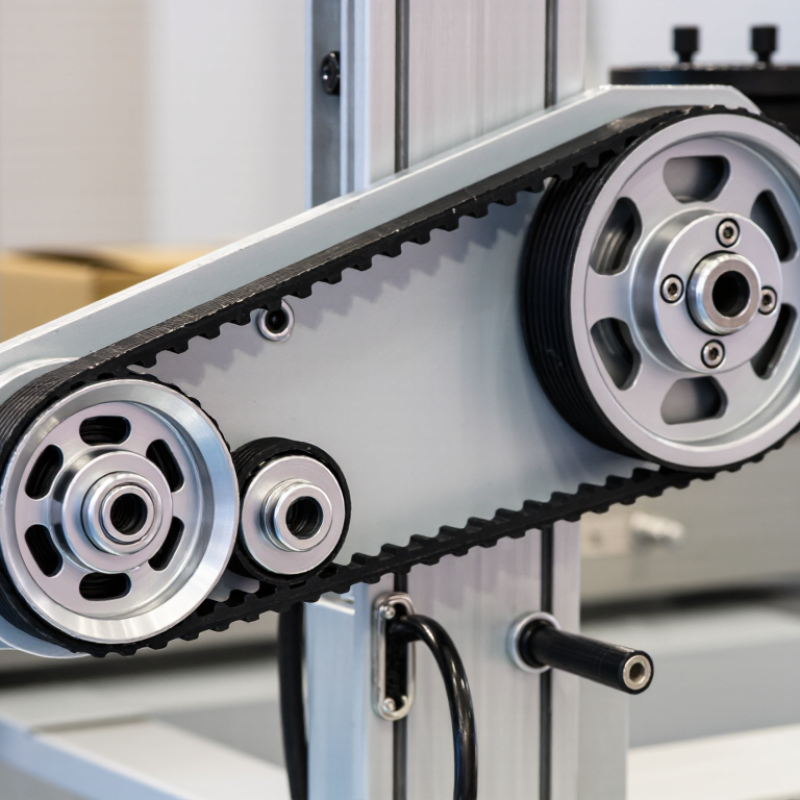
Why Choose a Rubber Timing Belt for Your Application?
How Rubber Timing Belts Transfer Motion
A rubber timing belt transfers motion through shaped teeth that mesh with matching pulley grooves. Unlike a friction belt, it does not depend mainly on surface contact. The tooth engagement keeps the driving and driven shafts synchronized during normal operation. Inside the belt, tensile cords resist stretching, while the rubber body supports repeated bending. As the motor turns one pulley, its teeth push against the belt teeth. The belt then carries that movement around the loop and drives the second pulley. Timing stays accurate when the belt is correctly tensioned.
This design suits machines requiring coordinated movement, such as conveyors, indexing systems, and compact automation equipment. It also runs quietly and needs no lubrication. Still, performance depends on real conditions. Excessive tension can damage bearings, while low tension may cause tooth jumping. Heat, dust, oil, and sharp pulley edges can shorten service life. In practice, calculations may miss sudden loads or poor alignment. That is where inspection matters.
Tips: Check alignment with a straightedge before startup. Set tension according to the equipment maker’s guidance, not by feel alone. Look for cracked teeth, shiny sidewalls, or unusual vibration. Replace the belt when wear becomes visible. A clean guard helps, but it cannot correct incorrect sizing.
How Rubber Timing Belts Transfer Motion
This chart shows the ideal motion relationship for an 8 mm pitch rubber timing belt running on a 20-tooth driving pulley and a 40-tooth driven pulley. The belt speed increases directly with driving speed, while the driven pulley rotates at half the input speed because the pulley tooth ratio is 2:1. Positive tooth engagement allows synchronous motion transfer without the slip associated with friction-only belts.
Material selection begins with the working environment. Most rubber timing belts use chloroprene or HNBR compounds, reinforced by fiberglass or aramid tensile cords. HNBR generally offers stronger heat and oil resistance than standard chloroprene. Still, it is not automatically the best choice.
The tooth section transfers torque without intentional slip. The tensile cords control belt length and protect timing accuracy. A nylon tooth jacket reduces friction and limits tooth wear. The back layer adds flexibility and shields the cords from contamination.
ISO 13050:2014 defines key dimensions for synchronous belt drives, helping engineers match pitch, width, and tooth geometry. Small mismatches can create noticeable vibration.
Field inspections often reveal the same issue: designers focus on torque but overlook temperature peaks, pulley alignment, and chemical exposure.
The U.S. Department of Energy’s Motor Systems Market Assessment reports that motor-driven equipment consumes about 69% of electricity used in U.S. manufacturing. Even modest transmission losses deserve attention.
A correctly tensioned rubber belt can operate quietly and needs no lubrication. That matters around clean machinery and enclosed guarding. However, rubber is not invincible. Excessive heat hardens the compound, while poor alignment concentrates wear on one edge. The specification may look correct on paper. The installation can still be wrong. Checking tension after initial running remains a practical, sometimes neglected, step.
Rubber timing belts deliver accurate, synchronized motion without metal-to-metal contact. That matters in packaging machines, conveyors, textile equipment, and small industrial robots. According to the U.S. Department of Energy’s motor-system guidance, synchronous belt drives can exceed 95% transmission efficiency when alignment and tension are correct. The result is less sliding, lower heat, and quieter operation on the factory floor. Quiet operation helps near inspection stations.
In automotive and agricultural equipment, rubber belts absorb vibration while maintaining precise shaft timing. A 2024 analysis from Grand View Research identifies transportation and industrial machinery as major demand areas for timing belt systems. Its findings reflect a practical trend: engineers want compact drives that reduce maintenance points. Rubber also tolerates brief shock loads better than many rigid drive components. Still, material selection matters. Oil, heat, dust, and continuous flexing can shorten belt life.
Maintenance teams usually notice the warning signs first: polished teeth, edge wear, or unusual chirping. Replacing a belt only after failure is a poor calculation. The European Committee for Standardization’s belt-drive guidance emphasizes correct tension, pulley alignment, and inspection intervals. In real applications, these details are sometimes rushed. That is the uncomfortable part. A well-designed belt can underperform when installation is careless. Engineers should verify temperature range, torque, speed, and contamination before choosing the rubber compound. Performance depends on the whole system, not the belt alone.
Choosing a rubber timing belt starts with the machine, not the belt catalogue. Measure everything. Record torque, speed, start-up load, operating hours, and shaft spacing. Rubber belts offer quiet, clean power transfer and accurate synchronization. They often suit conveyors, pumps, packaging equipment, and moderate-temperature drives. However, quiet does not mean maintenance-free. A loose belt may skip teeth beside a warm motor.
To select correctly, match tooth pitch and profile to torque and pulley diameter. Calculate belt width from peak load, not average running load. Check the belt’s temperature range, oil exposure, moisture, dust, and cleaning chemicals. A belt near a hot guard may age faster than its specification suggests. Alignment deserves equal attention. Even a strong belt can track poorly when pulleys are offset by a few millimeters. Tension should follow measured installation values, rather than feel. Feel can mislead.
Reliable selection also depends on evidence. Use tested load ratings, dimensional tolerances, and documented material data. Ask whether the belt will face reverse bending, frequent stops, or sudden acceleration. Inspect pulley teeth for burrs and wear before installation. A new belt cannot correct damaged hardware. One easy mistake is choosing extra width without checking pulley space and shaft loading. More is not always better. Review the calculation with maintenance staff, because they know the noise, heat, and dust the drawing may miss. Recheck after the first operating cycle.
| Selection Factor | Typical Rubber Timing Belt Characteristic | Practical Selection Guidance | Application Benefit | Importance |
|---|---|---|---|---|
| Positive Drive | Teeth engage with matching pulley grooves to prevent normal slip. | Choose a synchronous belt when accurate shaft timing or repeatable positioning is required. | Reliable motion transfer and improved indexing accuracy. | High |
| Operating Temperature | Standard rubber compounds commonly support approximately -30°C to 80°C, depending on construction and service conditions. | Check the belt manufacturer’s temperature range and consider a heat-resistant compound for continuous operation above the standard range. | Helps reduce premature hardening, cracking, and loss of tooth integrity. | High |
| Speed Capability | Rubber timing belts are suitable for many low- to high-speed power-transmission systems when correctly tensioned. | Verify the belt pitch, pulley diameter, belt width, and manufacturer-rated linear speed for the intended drive. | Supports smooth operation while limiting vibration and tooth wear. | High |
| Torque and Load | Load capacity depends on belt width, tooth profile, tensile cords, pulley size, and service factor. | Calculate design torque, peak loads, start-up loads, and shock loads rather than sizing only for average power. | Reduces the risk of tooth shear, belt stretch, and ratcheting. | High |
| Noise and Vibration | Rubber belts generally operate more quietly than chain drives and do not require metal-to-metal lubrication. | Use an appropriate tooth profile, pulley alignment, and tension setting for noise-sensitive equipment. | Improves operator comfort and helps protect nearby components. | Medium |
| Maintenance Requirements | Timing belts normally require no routine lubrication and have relatively simple inspection requirements. | Inspect for cracks, fraying, tooth wear, contamination, and incorrect tension at scheduled intervals. | Can lower routine maintenance time and prevent lubricant-related contamination. | High |
| Chemical and Oil Exposure | Resistance varies by rubber compound; oils, fuels, solvents, and some chemicals can degrade standard materials. | Select a compatible compound or protective construction after identifying all fluids, cleaners, and process chemicals. | Extends service life in industrial and automotive environments. | High |
| Moisture and Contamination | Rubber belts can perform in damp conditions, but abrasive particles may accelerate tooth and pulley wear. | Use guards, sealed layouts, or a suitable contamination-resistant belt when dust, water, or debris is present. | Helps maintain tooth engagement and stable power transmission. | Medium |
| Space and Layout | Timing-belt drives can transmit power over a center distance with compact pulley arrangements. | Confirm available center distance, minimum pulley diameter, wrap angle, and required belt length. | Provides design flexibility in compact machinery. | Medium |
| Backlash and Positioning | Toothed engagement offers controlled motion, but belt elasticity and tooth clearance still affect positioning accuracy. | For precision motion, select a suitable pitch and width, minimize belt span, and apply the recommended pretension. | Improves repeatability in conveyors, automation, and positioning systems. | High |
| Pulley Alignment | Timing belts require properly aligned pulleys and correct tracking across the drive. | Check parallelism, shaft alignment, flange condition, and belt tracking during installation. | Reduces edge wear, noise, and the possibility of belt derailment. | High |
| Installation and Tension | Incorrect tension can cause tooth jumping, excessive bearing load, vibration, or shortened belt life. | Follow the specified tensioning method and avoid forcing the belt over the pulley during installation. | Promotes stable performance and protects shafts and bearings. | High |
| Service Life | Life depends on load, speed, temperature, contamination, alignment, tension, and pulley condition. | Use calculated design life, regular inspections, and preventive replacement for critical systems. | Improves equipment availability and reduces unplanned downtime. | High |
| Cost and Total Ownership | Rubber timing belts typically offer a moderate initial cost and low lubrication requirements. | Compare purchase price with installation time, maintenance, energy use, replacement frequency, and downtime risk. | Supports economical operation over the complete service period. | Medium |
Note: Actual performance depends on the belt construction, tooth profile, pulley design, operating conditions, installation quality, and the manufacturer’s published specifications.
A rubber timing belt can deliver clean, quiet, and precise power transmission, but its limits deserve careful attention. In field maintenance, I have seen belts fail early when engineers selected them by width alone. Heat, oil, abrasive dust, and repeated shock loads can change the result. Temperature matters greatly. Continuous exposure above the rated range may harden the rubber and weaken its teeth. Cold conditions can reduce flexibility during startup.
Not ideal.
Operating tension must match technical data, not a rough hand check. Too little tension allows tooth skipping, especially during sudden acceleration. Too much tension increases bearing loads and may shorten belt life. Pulley alignment also deserves measurement. A small angular error can push the belt toward one flange and wear its edges. Guarding helps prevent contamination, yet it can hide cracks during inspection. Access panels should support routine checks.
Choose the belt compound, tooth profile, and reinforcement for the actual duty cycle. A conveyor running eight hours daily differs from an indexing mechanism with frequent reversals. Record startup temperature, noise, dust exposure, and visible wear. These details improve replacement intervals. Still, calculations are not enough. Real installations may behave differently because of vibration, installation habits, or imperfect cleaning. A practical trial under normal load can reveal weaknesses before full deployment. Replace belts showing frayed edges, missing teeth, or deep surface cracks, even if they still run.
Shaped teeth mesh with matching pulley grooves. The belt carries rotation around the loop without relying mainly on friction. Tensile cords resist stretching, while the rubber body bends repeatedly. Timing remains accurate when tension and alignment are correct.
They suit conveyors, packaging machines, indexing systems, textile equipment, and compact automation machinery. These systems need coordinated shaft movement. Small robots may also benefit from their compact design and quiet running.
Tooth engagement reduces slipping during normal operation. The driving and driven shafts stay synchronized. No lubrication is normally needed. The choice is not automatic; contamination and shock loads still matter.
Yes, it usually runs quietly because there is no metal-to-metal contact. This helps near inspection stations or enclosed work areas. Noise can still indicate poor alignment, damaged teeth, or incorrect tension.
Properly aligned systems can exceed 95% transmission efficiency. Low sliding reduces heat and energy loss. Actual performance depends on tension, pulley condition, speed, torque, and contamination.
Excessive heat, dust, oil, continuous flexing, and sharp pulley edges can cause early wear. Excessive tension may damage bearings. Low tension can make teeth jump. The environment deserves more attention than it often receives.
Check for cracked teeth, polished tooth surfaces, shiny sidewalls, edge wear, chirping, or unusual vibration. A straightedge can reveal pulley misalignment. Visible wear should not be ignored. Waiting for failure is a poor calculation.
Follow the equipment maker’s guidance rather than judging tension by hand. Confirm alignment with a straightedge before startup. A clean guard can block debris, but it cannot fix incorrect sizing. I would still recheck tension after initial operation.
A Rubber Timing Belt transfers motion through precisely formed teeth that mesh with matching pulley grooves, maintaining accurate synchronization between rotating components. Its construction typically combines a durable elastomer body with reinforced tensile cords and wear-resistant tooth surfaces. This structure allows the belt to operate quietly, deliver efficient power transmission, and require less lubrication than many alternative drive systems. Depending on its design, it can support applications involving automation equipment, conveyors, engines, pumps, and other machinery where reliable timing and controlled movement are important.
Selecting the right Rubber Timing Belt requires considering torque, speed, temperature, operating environment, pulley size, belt length, and expected service life. Material compatibility and resistance to oil, moisture, abrasion, or chemicals may also influence performance. Although rubber belts offer many advantages, they can be affected by excessive heat, contamination, misalignment, over-tensioning, and loads beyond their rated capacity. Proper installation, alignment, tension adjustment, and regular inspection are therefore essential for maintaining dependable operation and preventing premature wear.
