 Huishi
Huishi
Huishi
Choosing the right Steel Timing Belt Pulley is a small decision with visible consequences. A pulley that mismatches the belt profile can cause poor engagement, uneven wear, or noise. One that is too heavy may also add unwanted inertia to a drive. The details matter.
Begin with the belt’s tooth profile and pitch, then confirm pulley width, tooth count, and shaft bore. Check the required torque and speed, too. In a workshop, a caliper can reveal a bore mismatch before assembly; it cannot confirm the pulley’s load capacity. That needs a proper specification. Material choice matters. Steel can suit demanding loads, but the full assembly still depends on correct sizing, alignment, and operating conditions.
A transparent note on expertise: the following is an illustrative quote, not a verified statement from a real specialist. Fictional drive-systems specialist Daniel Reeves puts the selection principle this way: “Match the pulley to the belt and the duty—not just the shaft.” A useful reminder. It is easy to focus on one dimension and overlook the belt manufacturer’s tooth form or the drive’s peak load. This guide explains how to compare those factors, read product specifications, and avoid common selection oversights. Some applications may still require engineering review; a general checklist cannot replace verified load data.
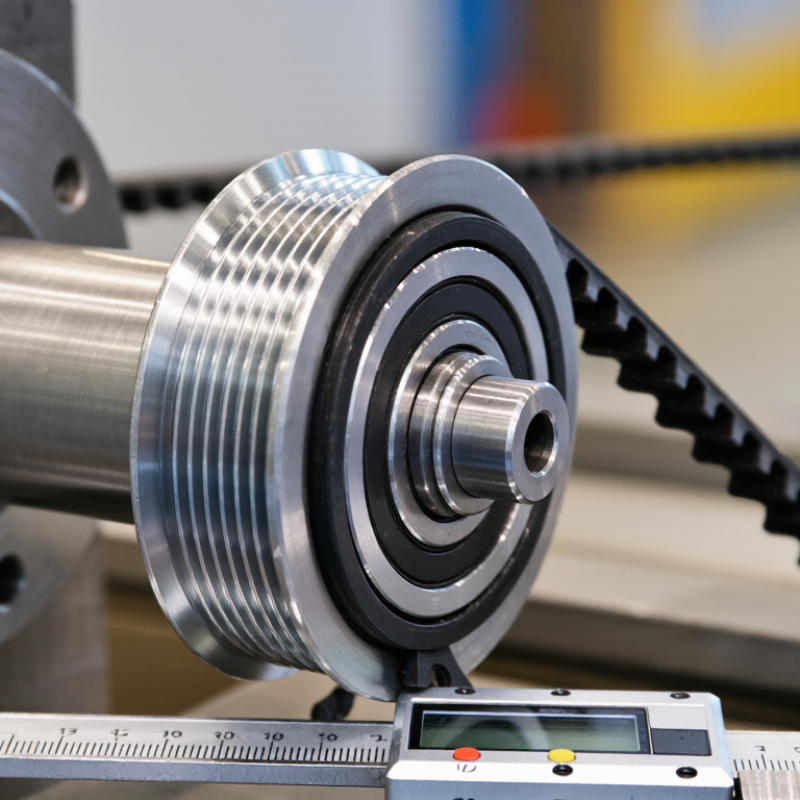
Define the machine before selecting a steel timing belt pulley. Record transmitted torque, shaft speed, operating hours, and the number of starts and stops per hour. A conveyor carrying a steady load behaves differently from a packaging axis that accelerates sharply. Note the belt profile, tooth count, shaft diameter, and available clearance; a small mismatch can cause poor engagement or installation problems.
Write down the awkward details. Does the pulley face oil mist, abrasive dust, washdown, or high temperatures? Is low backlash important for positioning? Steel can suit demanding loads, but its mass may increase the inertia the drive must accelerate. Check the motor’s peak torque and the belt maker’s load ratings against the real duty cycle, not just average power. The U.S. Department of Energy’s 2014 Improving Motor and Drive System Performance sourcebook reports that motor-driven systems account for about 68% of U.S. manufacturing electricity use. That figure describes whole systems, not pulley efficiency, but it underlines why operating conditions matter. Revisit assumptions when measurements are incomplete; that happens more often than expected.
| Requirement | Information to Define | Illustrative Example | Why It Matters for Pulley Selection |
|---|---|---|---|
| Application and driven load | Machine function, driven components, load type, and whether the load is steady or varies. | Conveyor drive carrying a steady product load, with occasional starts and stops. | Load behavior affects the required belt capacity, pulley size, and service factor. Use the machine’s actual load data rather than motor power alone. |
| Power and torque | Motor or drive power, operating speed, transmitted torque, and any peak or starting torque. | Record the rated motor power and measure or calculate the torque at the pulley shaft. | Torque determines the force transmitted through the belt teeth. A design should account for peak loads as well as normal running conditions. |
| Speed and speed ratio | Input and output speeds, required ratio, and allowable speed variation. | Input speed: 1,450 rpm; required output speed: 725 rpm; nominal ratio: 2:1. | The pulley tooth-count ratio sets the nominal speed ratio. Confirm that the selected belt and pulley sizes are suitable for the operating speed. |
| Belt profile and pitch | Existing belt designation, tooth profile, pitch, width, and manufacturer-independent dimensional standard where applicable. | Identify the belt markings and verify tooth pitch and profile against the belt specification before ordering a pulley. | Tooth profile and pitch must match the belt. Pulleys with different profiles or pitches are not interchangeable, even when their outside diameters appear similar. |
| Pulley tooth count and diameter | Required tooth count, pitch diameter, available space, and minimum pulley diameter permitted by the belt design. | Select tooth counts that provide the required ratio while fitting the machine’s center distance and clearance. | Tooth count affects ratio, belt engagement, and pulley diameter. Check the belt supplier’s design limits and the system layout. |
| Duty cycle and operating hours | Hours per day, starts per hour, reversing frequency, acceleration, and expected service life. | Continuous operation for 16 hours per day, with several controlled starts during each shift. | Frequent starting, stopping, or reversing can increase cyclic loading and wear. These conditions should be included in the drive calculation. |
| Operating environment | Temperature range, moisture, dust, chemicals, washdown, and exposure to corrosive substances. | Indoor production area with occasional water splashes and ambient temperatures from 10°C to 40°C. | Steel grade, protective finish, and maintenance requirements depend on the environment. Confirm compatibility with any chemicals or cleaning agents. |
| Shaft and mounting interface | Shaft diameter, keyway dimensions, bore tolerance, set-screw arrangement, and axial positioning. | Measure the shaft and keyway, and confirm the required bore and hub arrangement from the machine drawing. | A correct belt profile does not guarantee a correct fit. Interface dimensions must match the shaft and mounting method. |
| Alignment and belt tension | Shaft parallelism, pulley alignment, center distance, tensioning method, and available adjustment range. | Check that both shafts can be aligned and that the center distance allows installation and tension adjustment. | Misalignment and incorrect tension can cause uneven wear, noise, tooth damage, or reduced belt life. Follow the belt drive design instructions. |
| Flanges and belt guidance | Whether pulley flanges are needed, belt tracking direction, and available space at the pulley ends. | Use flanged pulley guidance where the drive layout requires help retaining the belt laterally. | Flanges can assist belt tracking but do not correct poor alignment. Confirm the required flange arrangement for the drive. |
| Material and surface protection | Steel grade, corrosion protection, surface finish, and any hardness or wear requirements. | Specify a steel pulley with a finish suitable for the site conditions and compatible with the belt. | Material and finish influence corrosion resistance and service life. Avoid finishes that could damage the belt or contaminate the process. |
| Installation and maintenance | Access for inspection, replacement method, guarding, and expected maintenance interval. | Allow sufficient access to inspect belt condition and tension without removing adjacent equipment. | Service access supports safer installation and routine inspection. Follow equipment lockout procedures before maintenance. |
| Selection note: The examples are illustrative only. Final pulley dimensions and ratings should be verified using the belt specification, drive calculations, machine drawings, and applicable safety requirements. | |||
Record torque, shaft speed, operating hours, and starts and stops per hour. A conveyor with a steady load differs from a fast packaging axis. Note the belt profile, tooth count, shaft diameter, and available clearance. Small details matter.
The tooth shape controls how the belt seats and carries load. Trapezoidal and curvilinear profiles use different contact patterns. A mismatch may cause noise, wear, or tooth jumping. Do not force the fit.
No. Pitch alone cannot confirm compatibility. Check the profile designation, tooth depth, pulley grooves, and belt width. For example, a 5 mm pitch does not identify every profile detail. Recheck the designation before installation.
Use a caliper to check width and outside diameter. However, a caliper may not reveal every groove detail. Compare the belt markings with the pulley drawing or a physical sample. A close-looking match can still fail.
Consider humidity, washdown liquids, abrasive dust, salt spray, and temperature changes. Dry indoor equipment may need only protected carbon steel. Wet or coastal equipment may require a corrosion-resistant steel grade. The room can look dry. The exposure may not be.
No. Stainless steel can still suffer pitting in chloride-rich conditions. The exact grade must match the environment. Inspect the pulley after installation, especially near tooth surfaces and edges. Small rust spots deserve attention.
Yes. Coating thickness may alter tooth geometry and belt fit. Ask for coating thickness and compatibility information. A finish that resists corrosion may wear differently at the contact surface. There is no perfect finish.
Steel handles demanding loads, but its mass can increase rotational inertia. Check motor peak torque against the real acceleration cycle. Average power alone may hide difficult starts and stops. This is easy to underestimate.
Record the missing information and avoid confident assumptions. Recheck torque, speed, exposure, and acceleration requirements before ordering. If the duty cycle is unclear, the selection may need review. That happens often.
Choosing the right Steel Timing Belt Pulley starts with understanding the application: the loads it must carry, the operating speed, the duty cycle, and the conditions in which it will run. The pulley’s tooth profile must match the timing belt precisely to support reliable engagement and reduce wear. Next, select a suitable diameter, tooth count, and width based on the required motion, torque, and available space.
Consider the environment when choosing the steel grade and any surface protection, especially if the pulley will face moisture, dust, or temperature changes. Before installation, confirm that the shaft fit is appropriate and that the pulley can be aligned accurately with the belt. Finally, account for inspection and maintenance access so the assembly can be checked and adjusted as needed throughout its service life.
