
Huishi
Choosing the 2026 Best Aluminum Timing Belt Pulley Suppliers requires more than comparing catalog prices. Tooth accuracy, bore tolerances, surface finish, and hub strength directly influence motion quality. A poorly finished pulley can create vibration, noise, and uneven belt wear within weeks.
Industry reports support this growing focus on precision. Fortune Business Insights’ timing belt market analysis identifies automation, robotics, and advanced manufacturing as major demand drivers through the decade. Grand View Research also links lightweight aluminum components with efficiency improvements in industrial equipment and transportation systems. These reports offer useful direction, but they do not replace supplier-level testing. That distinction matters.
Real applications reveal the difference.
Dr. Alexander H. Slocum, author of Precision Machine Design, has stated, “Precision must be designed into the machine, not inspected into it.” This principle fits every Aluminum Timing Belt Pulley evaluation. Buyers should request material certificates, dimensional inspection records, anodizing details, and verified runout measurements. ISO 5294 tooth-profile requirements can provide a useful reference, although compliance alone does not guarantee excellent service life.
The strongest suppliers usually explain their alloy choice, machining process, balancing method, and quality controls. Some publish impressive tolerances. Others provide very little evidence. That should encourage reflection.
A lighter pulley may reduce rotating inertia, yet insufficient hub thickness can weaken the assembly. Hard anodizing may improve wear resistance, but poor coating control can affect tooth dimensions. In 2026, the best supplier will not simply sell aluminum pulleys. It will demonstrate repeatable accuracy, application knowledge, responsive engineering support, and honest limitations. Those details deserve closer attention than a low quotation.
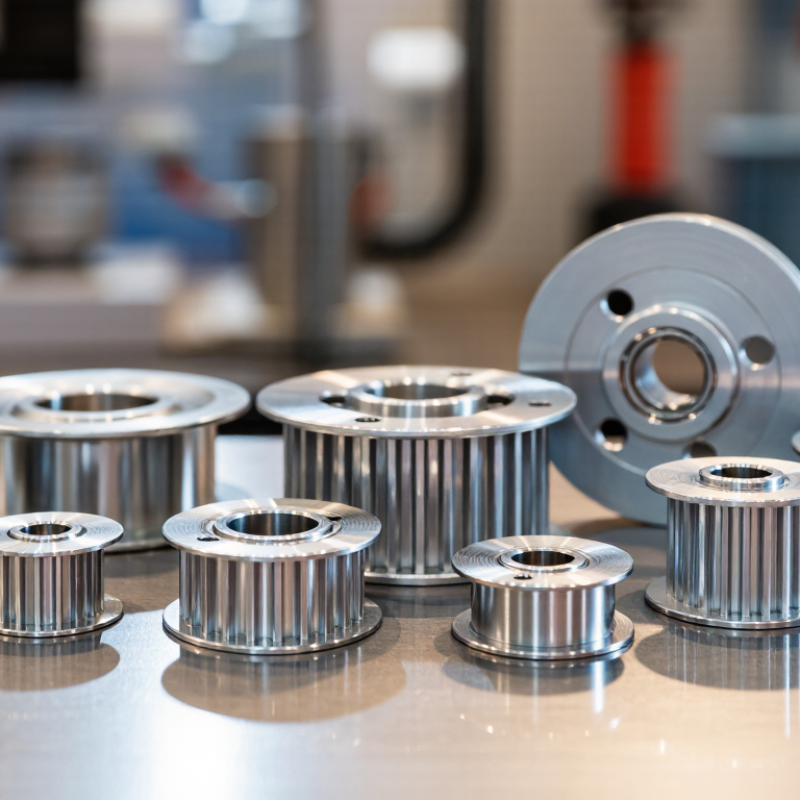
What Defines a High-Quality Aluminum Timing Belt Pulley Supplier in 2026
A reliable supplier should prove performance, not merely display attractive product photos. Grand View Research valued the global industrial automation market at USD 211.44 billion in 2023, with a projected 9.3% CAGR through 2030. That growth increases demand for accurate, lightweight motion components. However, automation growth does not guarantee pulley quality. Ask for alloy certificates, tooth-profile inspection records, dimensional reports, and batch traceability. Numbers matter.
Experienced suppliers should identify the aluminum grade, temper, surface treatment, and allowable runout. For many applications, 6061-T6 offers a practical balance between strength, machinability, and weight, but it is not ideal for every load. A serious supplier should explain that limitation. They should also provide bore tolerances, keyway details, balancing data, and operating temperature ranges. Request samples before approving volume production. Check tooth engagement, flange alignment, and visible anodizing defects under workshop lighting. Small errors become noise, belt wear, or lost positioning accuracy.
ISO 9001 certification can support process control, but it cannot replace independent inspection. That distinction is often missed. A 2024 timing-belt market assessment by Mordor Intelligence forecasts steady growth through 2030, making supplier selection more important as sourcing expands. Ask how rejected parts are handled. Ask for corrective-action records. A polished catalogue proves little. Consistent evidence does.
2026 Best Aluminum Timing Belt Pulley Suppliers?
Key Materials, Designs, and Specifications for Aluminum Timing Belt Pulleys
Choosing an aluminum timing belt pulley starts with the alloy, not the finish. In most light and medium-duty applications, 6061-T6 offers a practical balance of strength, machinability, and cost. For higher torque or reduced weight, 7075-T6 may perform better, though it usually costs more. Steel hubs or inserts can strengthen the bore when repeated tightening creates stress. Anodizing improves surface hardness and corrosion resistance. It does not fix poor machining.
Tooth geometry must match the belt profile precisely. Common specifications include pitch, tooth count, outside diameter, flange width, bore size, keyway dimensions, and allowable speed. A pulley with 20 teeth and a 5 mm pitch needs different belt engagement than one with 32 teeth and the same pitch. Ask suppliers for dimensional drawings, material certificates, hardness data, and measured runout. A realistic target is often below 0.05 mm, but the machine’s speed and belt width should determine the final tolerance.
Supplier reliability becomes visible during inspection. Experienced manufacturers should explain how they control concentricity, tooth accuracy, balancing, and batch traceability. I have seen lightweight pulleys fail because the bore was accurate, but the flange was misaligned. That detail is easy to miss. Request sample inspection reports and confirm whether custom keyways, clamping hubs, or black anodizing are available. Some catalog specifications look complete. They are not always complete. Ask about temperature limits, surface treatment thickness, and replacement consistency before approving production quantities.
2026 Best Aluminum Timing Belt Pulley Suppliers?
How to Evaluate Supplier Quality, Manufacturing, and Certification
A reliable supplier should explain its aluminum grade, heat treatment, and pulley design clearly. Ask for the alloy designation, hardness range, and material traceability before approving samples. The tooth profile must match the belt specification precisely. Small errors can create vibration, noise, or early belt wear. Request dimensional reports for bore size, pitch diameter, flange width, and runout. Numbers matter.
Manufacturing controls reveal more than attractive product photos. Check whether the supplier uses CNC machining, calibrated measuring equipment, and controlled anodizing processes. Surface finish should protect against corrosion without changing critical dimensions. Ask how rejected parts are isolated and recorded. A clear inspection plan is valuable. It should cover incoming material, in-process checks, and final inspection. Sample reports should include actual measurements, not only pass marks. I would also request a pilot batch. Large orders can expose weaknesses that samples hide.
Certification requires careful reading. An ISO 9001 certificate supports process management, but it does not guarantee every pulley is perfect. Verify the certificate scope, issuing body, validity date, and manufacturing location. Material certificates should connect directly to the batch shipped. Depending on the market, environmental declarations or restricted-substance compliance may also matter. Be cautious with vague claims. A supplier that answers technical questions slowly may still produce good parts, but that uncertainty deserves attention. Even experienced buyers can overlook packaging, concentricity, or storage conditions. That is where evaluation becomes less comfortable—and more useful.
2026 Best Aluminum Timing Belt Pulley Suppliers?
Comparing Pricing, Customization, Lead Times, and Order Requirements
Choosing an aluminum timing belt pulley supplier requires more than comparing unit prices. A low quote may exclude anodizing, inspection, packaging, or tooling charges. Request a complete quotation with material grade, bore tolerance, tooth profile, surface finish, and shipping terms. For small orders, setup fees can exceed the pulley cost. For larger orders, ask whether volume pricing applies consistently.
Customization often affects both lead time and minimum order quantity. Standard bores may ship quickly, while unusual keyways, flange shapes, or lightweight webs require drawings and machining trials. Ask for a sample approval process before production. A reliable supplier should provide dimensional reports and explain its inspection equipment. I have seen schedules slip because a drawing lacked datum references. That mistake is avoidable, but not always caught early.
Tips: Send a controlled drawing, target quantity, and application details together. Ask for tooling ownership, replacement policies, and realistic production dates. Separate sample lead time from mass-production lead time. Check whether the quoted date starts after payment or drawing approval. Do not trust vague promises. A written milestone plan is safer. Also, review the supplier’s response quality; unclear answers may signal future problems. My own evaluation can be imperfect, especially when technical assumptions remain untested. Allow a small schedule buffer, even with an experienced manufacturer.
The chart compares anonymized supplier profiles by indicative unit price, standard lead time, minimum order quantity, and customization capability. Pricing is shown in USD per pulley for comparable production orders. Customization is rated from 1, limited standard options, to 5, full engineering customization.
These figures represent realistic 2026 planning benchmarks for aluminum timing belt pulleys and should be verified with supplier quotations. Lower prices may involve higher MOQs or longer production lead times, while highly customized orders typically require additional engineering review.
Selecting an aluminum timing belt pulley supplier in 2026 requires more than comparing unit prices. Your application may face high speed, dust, heat, or repeated start-stop loads. Ask for the alloy grade, hardness data, tooth profile, and balancing limits. A serious supplier should explain how each choice fits your torque and belt width. Specific answers matter. Vague promises do not.
Request sample inspection records, dimensional tolerances, surface treatment details, and material traceability. For example, a 20 mm pulley should show bore size, keyway accuracy, and runout measurements. Confirm whether the supplier uses controlled machining and checks tooth geometry after finishing. Ask how rejected parts are isolated. This reveals process discipline. Experience also appears in practical questions about flange clearance, bearing loads, and installation tools. If they only discuss delivery speed, look deeper.
Evaluate communication during a small pilot order. Measure noise, belt tracking, temperature, and wear after realistic operating cycles. Keep photos and readings, even when results look acceptable. They expose small issues early. A reliable supplier will review failures without defensiveness and propose measurable corrections. Also verify packaging, replacement support, and change-control procedures. One weakness remains easy to miss: a polished sample may not represent every production batch. Request recurring inspection data, not one impressive report. Your machine deserves evidence that survives real production conditions.
| Evaluation Dimension | Recommended Technical Benchmark | What to Verify With the Supplier | Application Relevance | Suggested Weight |
|---|---|---|---|---|
| Aluminum Alloy Selection |
6061-T6: general-purpose pulley applications; density approximately
2.70 g/cm³ and ultimate tensile strength commonly around 290–320 MPa. 7075-T6: higher-strength, lightweight applications; density approximately 2.81 g/cm³ and ultimate tensile strength commonly around 500–570 MPa. |
Request the alloy designation, heat-treatment condition, material certificate, and traceability information for each production batch. | 6061-T6 is generally suitable for standard automation and motion systems. 7075-T6 can be considered where higher tooth load, lower deflection, or improved strength-to-weight performance is required. | 15% |
| Belt Profile and Pitch Compatibility | The supplier should manufacture the exact belt profile and pitch required by the application, such as metric pitches of 2, 3, 5, 8, or 14 mm, or inch pitches such as XL, L, H, or XH. | Confirm the belt standard, pitch, tooth form, tooth count, flange arrangement, belt width, and whether the pulley is intended for a single-sided or double-sided belt. | A pulley with the wrong tooth geometry or pitch can cause premature tooth wear, noise, vibration, belt skipping, and reduced transmission accuracy. | 15% |
| Dimensional Accuracy | For precision assemblies, specify the bore tolerance, keyway dimensions, outside diameter, pitch diameter, face width, and flange position on the drawing. An H7 finished-bore target is commonly used when the mating shaft and fit requirements support it. | Request a controlled engineering drawing, dimensional inspection report, calibrated measuring equipment records, and defined acceptance limits before mass production. | Accurate pitch diameter and bore geometry help maintain belt tension, center distance, positioning repeatability, and smooth power transmission. | 15% |
| Runout and Concentricity | For many small and medium precision pulleys, a project-specific total indicated runout target of approximately 0.03–0.05 mm may be appropriate. High-speed or high-precision applications may require tighter limits. | Verify how radial runout, axial runout, and bore-to-pitch-diameter concentricity are measured. Require inspection results from finished pulleys rather than only machining-process claims. | Excessive runout can produce belt vibration, uneven tooth loading, fluctuating tension, positioning errors, and accelerated wear. | 12% |
| Surface Treatment and Wear Resistance | Protective anodizing is commonly used for aluminum pulleys. Typical decorative or protective anodizing may be approximately 5–25 μm, while hard anodizing is often specified at approximately 25–50 μm, subject to dimensional compensation. | Confirm coating type, thickness, hardness, color consistency, sealing method, masking areas, dimensional allowance, and corrosion-resistance test requirements. | Surface treatment improves corrosion resistance and surface durability. The coating must not alter tooth geometry beyond the permitted tolerance or create excessive belt friction. | 10% |
| Dynamic Balance Capability | For rotating pulleys, balance requirements should be defined according to operating speed. ISO 21940 balance grades such as G6.3 or G2.5 may be used as project references when applicable. | Ask whether balancing is static or dynamic, identify the applicable balance grade, and request a balancing report for assemblies operating at elevated speed. | Appropriate balancing reduces vibration, bearing loading, acoustic noise, and fatigue risk in high-speed belt-drive systems. | 10% |
| Load, Speed, and Life Verification | The supplier should validate the pulley against the selected belt manufacturer's allowable tooth load, transmitted torque, belt speed, wrap angle, service factor, and expected operating life. | Provide or request calculations covering torque, speed, number of teeth, belt width, shaft diameter, keyway strength, flange retention, and maximum permissible operating conditions. | Aluminum pulley selection must be based on the complete belt drive. Tooth count and belt width influence load capacity, while speed and acceleration influence fatigue and vibration. | 12% |
| Manufacturing Process | CNC machining from certified aluminum bar or billet is generally preferred for precision prototypes and low-to-medium volumes. Forging or specialized production processes may be evaluated for larger volumes or higher strength requirements. | Review machining capability, tooling control, tooth-form inspection, deburring standards, process control plans, and the supplier's ability to maintain repeatability across batches. | Process capability directly affects tooth accuracy, concentricity, surface finish, lead time, and the consistency of replacement pulleys. | 8% |
| Quality Management and Documentation | A documented quality system, preferably certified to ISO 9001, should support incoming material control, in-process inspection, final inspection, nonconformance handling, and traceability. | Request material certificates, dimensional reports, coating records, calibration evidence, certificate of conformity, sample approval records, and corrective-action procedures. | Complete documentation reduces technical risk and helps maintain consistent quality in regulated, export, or safety-critical applications. | 8% |
| Prototype and Customization Support | The supplier should support custom tooth counts, bores, keyways, flanges, surface treatments, balancing requirements, and special mounting features without changing the functional belt profile. | Evaluate drawing review, engineering feedback, prototype inspection, revision control, sample approval, and the ability to manufacture small quantities before production release. | Strong engineering support lowers the risk of mismatched components and allows the pulley to fit the shaft, belt, guarding, and available installation space. | 5% |
Request alloy certificates, hardness data, dimensional reports, and batch traceability. Numbers matter. Each document should match the shipped production batch.
A common heat-treated aluminum grade balances strength, machining ease, and low weight. However, it may not suit every torque or temperature. A capable supplier should explain its limitations clearly.
Review bore size, pitch diameter, flange width, keyway accuracy, and runout measurements. Ask for actual readings, not only pass marks. A sample pulley should be checked under workshop lighting.
Accurate teeth support smooth belt engagement and stable positioning. Small errors can cause vibration, noise, and early belt wear. Small errors grow.
Look for controlled CNC machining, calibrated measuring tools, and documented inspection stages. Checks should cover incoming materials, machining, finishing, and final assembly. The process should be repeatable.
No certification can replace independent inspection and production evidence. Verify the certificate scope, validity, issuing body, and manufacturing location. Certification helps, but it is not proof of perfection.
Confirm that the treatment resists corrosion without changing critical tooth or bore dimensions. Inspect for uneven color, scratches, peeling, and visible defects. Appearance can mislead.
Measure belt tracking, operating noise, temperature, wear, and positioning accuracy. Use realistic start-stop cycles and operating loads. Keep photos and readings, even when results look acceptable.
Ask about rejected parts, corrective actions, packaging, storage, and change control. Clear answers suggest stronger process discipline. Still, communication alone cannot prove production consistency.
One polished sample may not represent every production batch. Request repeated measurements for runout, bore size, tooth geometry, and surface finish. I would not rely on one impressive report.
Finding the best Aluminum Timing Belt Pulley supplier in 2026 requires more than comparing prices. A reliable supplier should offer high-grade aluminum alloys, precise tooth profiles, stable dimensions, corrosion-resistant finishes, and designs compatible with different belt pitches, bore sizes, flanges, and torque requirements. Strong engineering support is also essential for applications involving automation, robotics, packaging equipment, and other demanding motion systems.
Supplier evaluation should include manufacturing capabilities, quality-control procedures, inspection equipment, traceability, and relevant certifications. Buyers should also compare customization options, minimum order quantities, sample policies, production lead times, packaging, and after-sales support. The most suitable supplier is one that balances material quality, dimensional accuracy, production consistency, delivery reliability, and total cost. By matching these factors with the timing belt’s load, speed, operating environment, and installation requirements, customers can select an Aluminum Timing Belt Pulley supplier that supports dependable performance and long-term system value.
